ERMIN MARKETING

Your customers already ask AI who to call. We make sure it names you

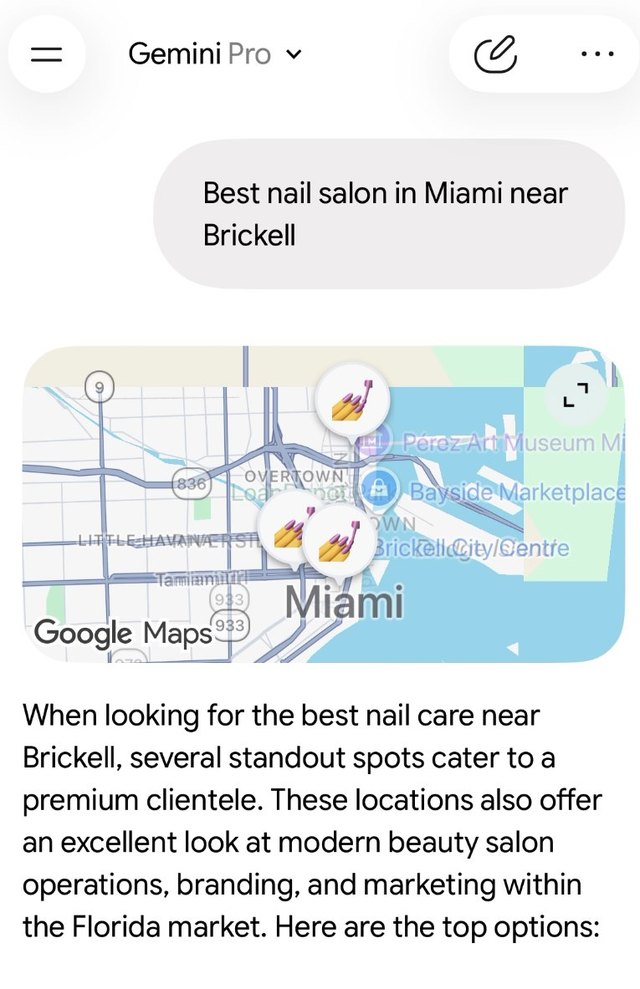
Gemini answering 'Best nail salon in Miami near Brickell' with a Google Maps embed and recommended salons

We get local businesses into the recommendations of ChatGPT, Copilot, Gemini and Google AI — across the US and Europe. Google profile, an AI-ready website, content and mentions — with a monthly measurement of your visibility share against competitors.

  • Step one — a $35 audit: we show what AI already answers in your niche, whether you appear, and who gets recommended instead of you.
  • Why us: we run projects with measurable citations, AI traffic in analytics, and leads sourced to chatgpt.com in the CRM — all shown on this page.
  • Why now: in most local niches, AI answers are not yet claimed by competitors. Whoever starts earlier is who AI learns first.
Order the AI audit — $35

Projects are run personally by the founder · Google AI Professional Certificate · US & Europe since 2016

Gemini answering 'Best nail salon in Miami near Brickell' with a Google Maps embed and recommended salons — this is how customers find local businesses through AI
Service
AI recommendation visibility
Where you appear
ChatGPT · Copilot · Gemini · AI Overviews · Ask Maps
Coverage
US & Europe
Measurement
Visibility panel · Bing AI Performance · GA4 · CRM
Pricing
Audit $35 · support from $900/mo
What's happening

Search is changing before our eyes — for the first time in Google's history

At Google I/O in May 2026, CEO Sundar Pichai called AI Mode the company's "biggest upgrade to Search ever": within a year it passed one billion monthly users, and AI Overviews answers reach more than 2.5 billion (keynote transcript on blog.google). AI assistants now live everywhere people search: in the browser, in the search bar, in Maps — where Ask Maps answers questions about businesses. As for how high the stakes are, investor Gavin Baker has recounted that Google co-founder Larry Page repeatedly told people inside the company he would rather go bankrupt than lose the AI race.

For a local business the more important part is that buyers already behave this way. Per a large survey of 1,200+ US consumers (July 2026), 31% use AI tools to find local businesses at least monthly, and 45% turned to AI for such recommendations in the past year — up from 6% a year earlier. For now AI builds the shortlist rather than making the decision: 43% of those who start with AI go on to verify the recommendation on Google — checking the profile, the reviews, the website.

2.5Bpeople see AI Overviews answers on Google every month
1BAI Mode users within its first year
31%of consumers search for local businesses via AI at least monthly
6% → 45%one-year growth in consumers asking AI for local business recommendations
The practical takeaway: AI and classic search work as a chain. AI names 2–3 businesses — the person verifies them on Search and Maps and chooses. That is why we run both sides of the funnel: AI recommendations bring customers to you, while your Google profile, reviews and website hold up to the check. Google Maps marketing is a separate service, and the two reinforce each other.
How it works

How AI decides who to recommend

Answering "which service is best in my area", AI does not invent the answer — it assembles it from sources: Google and Bing search results, the business profile, reviews, directory sites, and the text of your website. The largest correlation study of 2026 (403,000 prompts to 13 AI models across 100 industries — full study) found that recommendations correlate most strongly with your business being mentioned on pages that already rank for niche queries — twice as strongly as your own site's rankings. Second comes something simple: how directly your homepage answers what you do, where, and for how much.

What's included

Project support — from $900/mo. Your website is at the center

Why the website decides: AI recommends businesses it can read and cite. The second-strongest visibility signal in the research is how directly a site answers what you do, where, and at what price — and AI crawlers only read what is served ready-made. A website that looks good to people and a website AI pulls into its answers are two different things.

Across our projects the pattern repeats: websites are not ready for the AI transition. We bring the site up to technical readiness and then run it using a structure refined on the agency's projects. It is a monthly process driven by real query data, not a one-time setup: what people ask AI keeps shifting, and pages and answers are added to match. Alongside the site we manage the Google profile (which AI cites in our projects), external mentions, and measurement. The exact scope depends on your starting point — the audit locks it in.

Website AI-readiness assessment: all three scores in the yellow-red zone
BEFORE

What a typical website looks like at audit

The site works fine for people, but AI sees it only partially — all three readiness scores in the yellow-red zone. Your competitors most likely look the same. That is the opportunity: we have seen this many times and know what to do.

Website AI-readiness assessment · real project audit

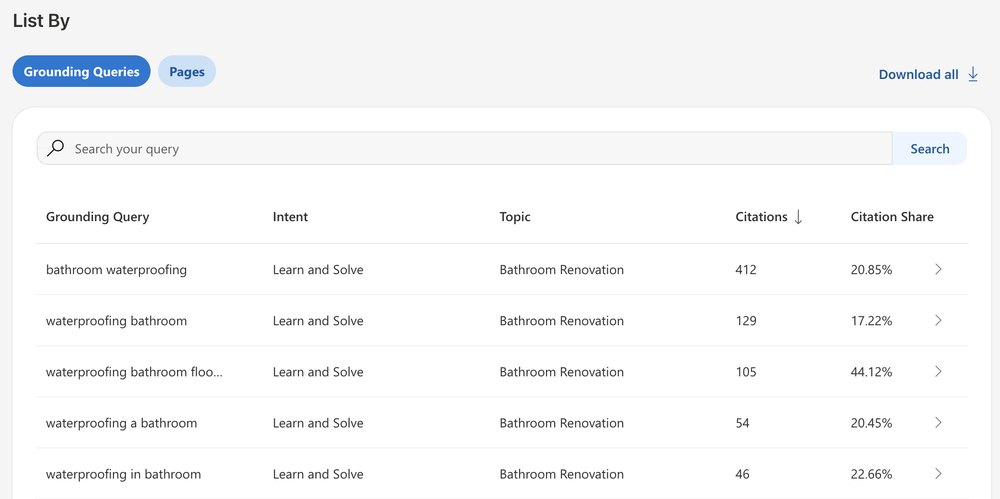
Report: real AI queries in the client's niche and citation share for each
PLAN

The work is built on real questions, not guesses

The actual phrasings people bring to AI in the client's niche, with the site's citation share for each — on one query, 44% of all links in AI answers point to the client's site. People ask the same question five different ways, and one properly built page covers the whole family. This data is what the monthly plan is assembled from.

Bing Webmaster Tools · AI Performance · client project

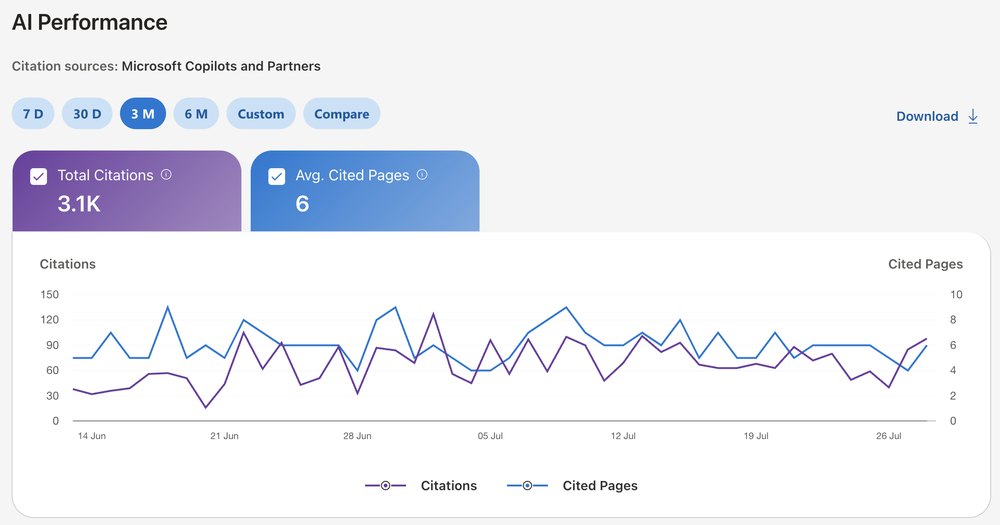
AI Performance report: 3,100 citations of the client's site by Microsoft AI systems over 3 months, 6 cited pages on average
AFTER

A website AI cites constantly

3,100 citations of the client's site by Microsoft AI systems over three months — steady, with no gaps. Six different pages cited on average: AI links to service pages, not just the homepage — the built-out structure is what's working.

Bing Webmaster Tools · AI Performance · 3 months · client project

Honest timelines

A process with measurable dynamics — not a button

Where the timelines come from. Google ships major core updates 3–4 times a year, and counting all named updates, something rolls out almost monthly; rollouts take 2–3 weeks, and Google advises waiting about another week before judging the changes (official calendar: Search Status Dashboard). In our Search Console and Bing measurements, visibility dynamics show up several weeks after updates. Hence the realistic horizon for first movement — 3+ months, with speed depending on the starting point.

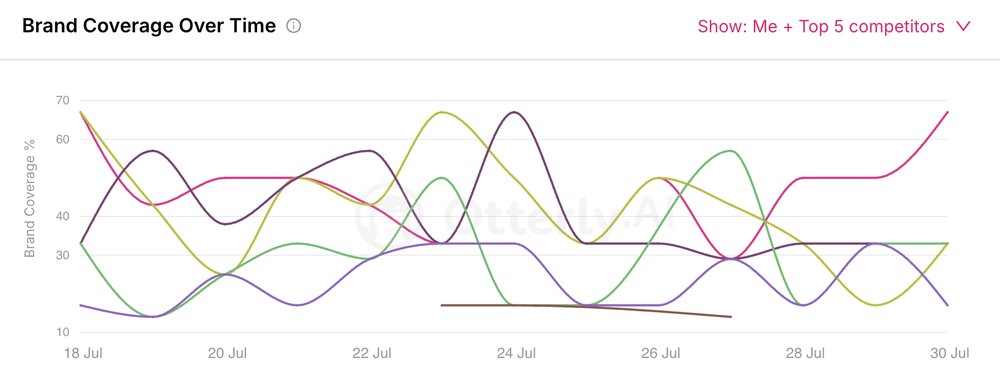
Two weeks of AI answer visibility for six brands: the lines constantly trade places

Why we don't promise "a spot in ChatGPT"

Two weeks in the life of one niche: the AI-answer visibility of six brands shifts daily, with leaders and challengers constantly trading places. The answer is generated fresh for every question — "locking in a position" is technically impossible, whatever you may be promised.

So what gets measured is not a "position" but your visibility share over time against competitors — weekly measurements over one fixed pool of queries.

Visibility monitoring panel · you + top-5 competitors · weekly snapshots

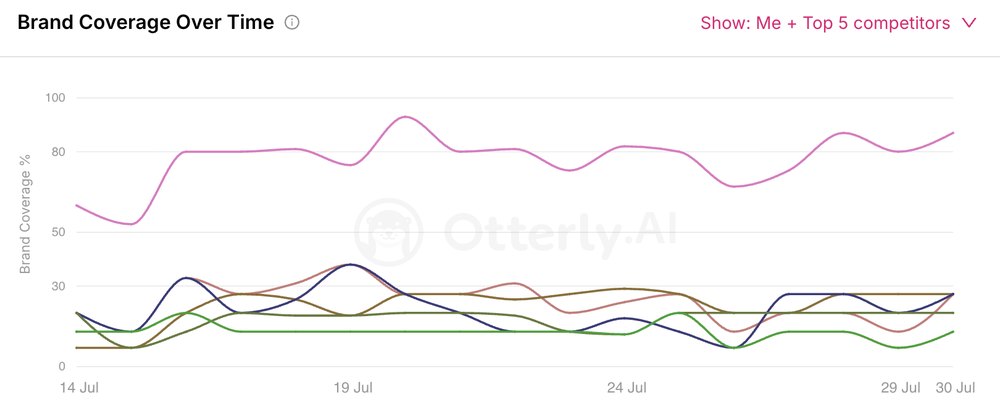
Brand visibility in AI answers growing from ~55% to a steady 80%+ while competitors stay below 40%

What visibility looks like on an accumulated foundation

A project with the groundwork in place — website, publications, external footprint: the brand shows up in 80%+ of AI answers across the niche query pool, with the nearest competitors below 40%. A gap like this is the result of accumulated work, not quick tricks; how fast you reach these numbers depends on the starting point — which the audit locks in.

Visibility monitoring panel · client project

A window of opportunity: in many local niches, competitors have not yet started working on AI visibility systematically. Whoever locks in a baseline and starts earlier accumulates that gap — and we see the full niche data from day one and throughout.
How we evaluate results

Three levels: visibility → traffic → inquiries

First the business appears in AI answers, then measurable traffic arrives, then inquiries. Every level is visible in the report.

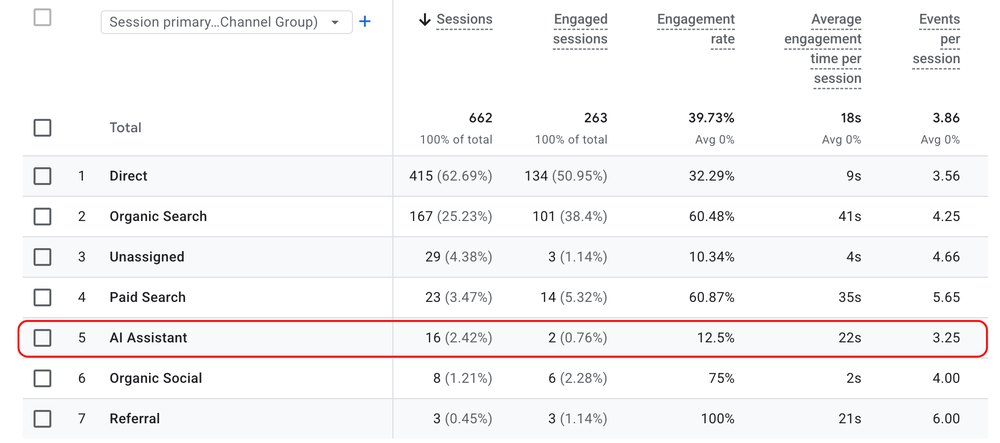
GA4 report: visits from AI tools separated into a dedicated AI Assistant channel — 2.4% of sessions

Level 2: AI traffic as its own channel in analytics

Visits from ChatGPT, Perplexity, Copilot and other AI tools are separated into a dedicated GA4 channel — 2.4% of sessions already today, and we report with a line in analytics, not with impressions.

Important: some AI visits lose their source tag and hide inside "direct" traffic — so we supplement analytics with CRM attribution and a "how did you hear about us" question in forms.

Google Analytics 4 · AI Assistant channel · client project

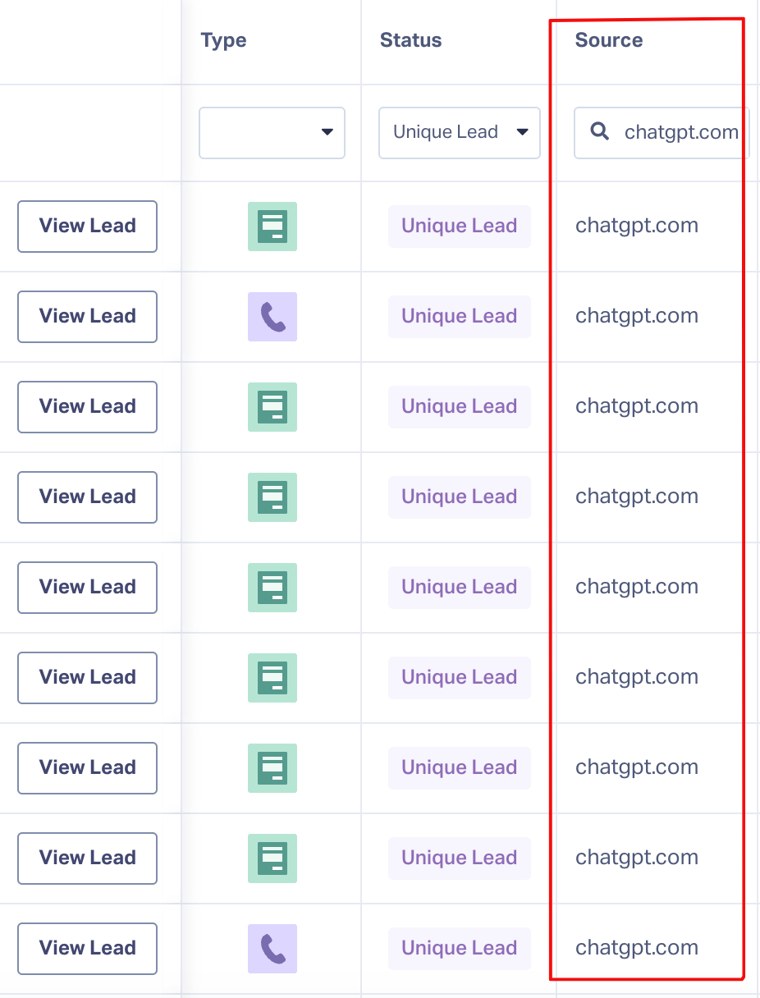
Client CRM: form submissions and calls with Unique Lead status and chatgpt.com as the source

Level 3: inquiries sourced to chatgpt.com in the CRM

What the visibility is built for: form submissions and phone calls whose CRM source reads chatgpt.com. These are hot inquiries — the person arrives after AI has already compared the options and recommended a specific business.

Inquiry volume depends on demand in your niche — our job is making sure your business is present where that demand takes shape, and showing the whole chain in the report.

CRM · filtered by source chatgpt.com · client project

Who runs the projects

A method backed by certification and partnership

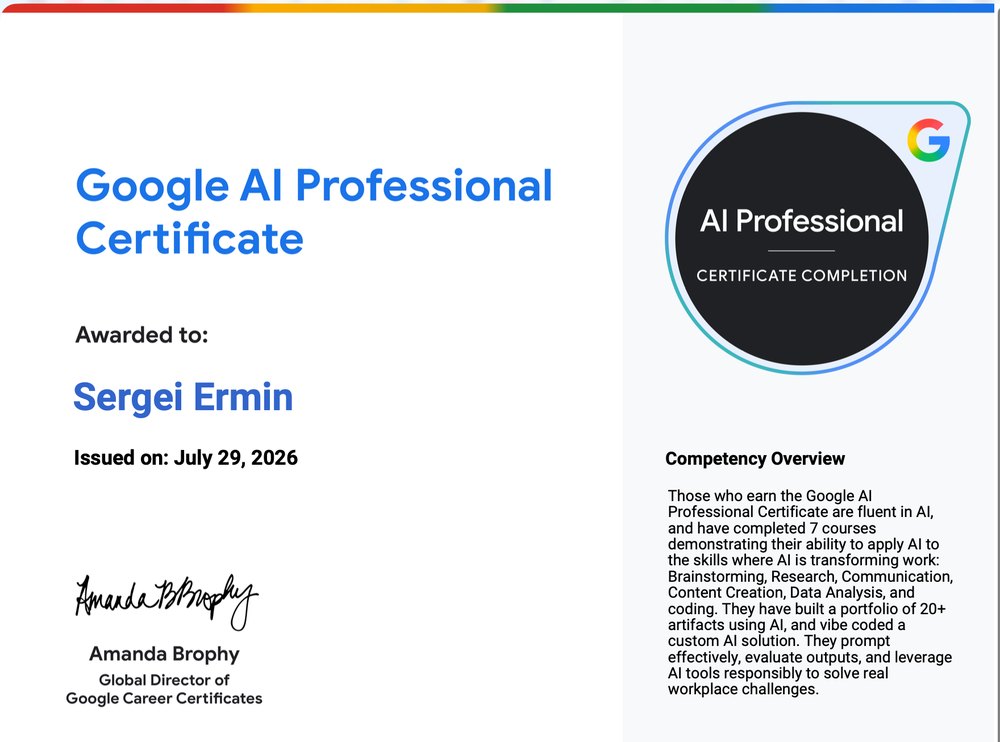
Google AI Professional Certificate, awarded to Sergei Ermin, July 2026

Google AI Professional Certificate — Google's 7-course program on applying AI at work: research, content creation, data analysis. Projects are run by agency founder Sergei Ermin — the same person who answers to you for every number in the report.

Official Otterly.AI Partner badge

Your share of AI answers is measured weekly over a fixed pool of real niche queries — against your top-5 competitors, from the same panel whose charts you see on this page (Ermin Marketing is an official partner of the Otterly.AI monitoring platform).

The essentials — in five points

  1. Buyers are already there. 31% of US consumers search for local businesses via AI at least monthly; in one year, the share asking AI for recommendations grew from 6% to 45%.
  2. AI builds the shortlist, Google closes the choice. 43% of those who start with AI go on to verify the recommendation on Search and Maps — you need the whole chain, not one channel.
  3. The main lever is mentions, not rankings. AI recommendations correlate most strongly with your business being mentioned on pages that already rank in the niche — plus a website that directly answers what you do, where, and at what price.
  4. It's a process with a 3+ month horizon. Search index updates ship in cycles and dynamics appear weeks after them; speed depends on the starting point — which the audit locks in.
  5. Everything is measurable. Visibility share against competitors, citations, AI traffic in GA4, inquiries in the CRM — the dynamics of these metrics are the report, not promises of "ranking #1".

Frequently asked questions

Do you guarantee a spot in ChatGPT answers?

No — and nobody can: the answer is generated fresh for every question, and brand visibility shifts daily (see the chart above). A "guaranteed #1 in ChatGPT" pitch is a sign you are being sold words, not work. We lock in a baseline, run the work that — per published research and our own practice — raises the probability of being recommended, and show the monthly dynamics of your visibility share against competitors.

How long until the first movement?

A realistic horizon is 3+ months. Google ships major core updates 3–4 times a year, rollouts take 2–3 weeks plus about a week for the data to settle; named updates overall land almost monthly. In our measurements, dynamics show up several weeks after updates. Speed depends on the starting point: faster with a solid website and external footprint; from zero, the foundation gets built first.

Why pay $35 for an audit when free checkers exist?

Because it is a manual assessment of your niche and location, not an automated report: what AI actually answers to your buyers' real questions, whether you appear, who gets recommended instead of you, which sources AI relies on — plus a technical check of whether AI crawlers can read your site. The result is a locked-in baseline and a specific work list. It stays with you either way.

We have no website — just a booking-service page. Where do we start?

A common and solvable situation. A booking-service page does not belong to you and gives AI almost nothing to cite — which is why building a website for AI search is included in project support when a website is needed. Across our projects the pattern repeats: websites are not ready for the AI transition, and we bring them up to readiness using a structure refined on the agency's projects — then run them monthly on query data. The specific work list for your website is set by the audit.

How is this different from regular SEO?

The foundation is shared: website, Google profile, mentions, reviews. The emphasis differs: per the largest study of 2026, AI recommendations correlate most strongly with mentions of your business on pages that already rank in the niche — twice as strongly as your own rankings. Add the technical layer (AI crawlers need ready HTML) and a different measurement system: your share of AI answers across a pool of real questions instead of keyword positions.

First step

Start with the AI visibility audit — $35

We lock in your starting point: what AI answers in your niche, whether you appear, who gets recommended instead of you, and whether your website is technically ready. Then — a specific plan, and the decision is yours.

Phone / WhatsApp+972 53-382-7132

Sources