A premium nail studio was already recommended by AI in a third of answers — but every citation pointed to a booking page or a directory. We built one deep page from the owner's own facts and gave the models something to quote. Here is what changed in AI answers, in Google and in Maps, with the caveats.
Three measurements on the same five local prompts, across ChatGPT, Perplexity, Google AI Overviews / AI Mode and Copilot: before any website, after a first simple version, and a month after the full page.
| Metric (5 tracked local prompts) | August — no website | Early October — first version | November — a month after the full page |
|---|---|---|---|
| Answers that mention the studio | 33% | 42% | 57% |
| Share of recommendations among 6 local salons | — | 34% | 41% (#1; next — 24%) |
| Average position in the answer | — | 1.4 | 1.4 |
| Citations of the studio's own site | 0 | 15 | 103 |
Measured with an AI visibility tracker on a fixed panel of five prompts — the questions a customer in that city actually asks (specialty + city, gel extensions + city, "best nail salon in [city]"). Share of recommendations is counted against five named local competitors. These are tracked-prompt figures, not general brand awareness.
The studio is a single-address salon suite in a suburb of a large US city: Russian-style dry manicure, hard-gel strengthening and extensions, smart pedicure, premium pricing from $90. A Google profile with 4.8 stars and 47 reviews. No website — the booking link went to an online scheduling page.
When we took the first measurement in August, AI already mentioned the studio in 33% of answers on our local prompts. But the sources behind those mentions were the booking page and third-party directories. The studio's own domain appeared in the citations zero times — there was no domain.
The rest of the sources in the niche were competitors' websites, booking marketplaces and "top-N salons in [city]" lists. Whoever had a page with facts was quoted; the studio had a page with a calendar.
AI answers to a question like "where do I get a Russian manicure in [city]" are assembled from pages the models can read. A directory says the name and the address. A booking page says the price of a slot. Neither says how the procedure is done, what materials are used, how tools are sterilized, what the warranty is — the things the question is really about. Without its own source the studio could be named but never explained.
Five local prompts tied to the city, the way a customer phrases them: specialty + city for manicure and for pedicure, gel extensions and builder gel + city, and "best nail salon in [city]". Tracked across ChatGPT, Perplexity, Google AI Overviews and AI Mode, and Copilot, against five local competitors. We also mapped the sources by hand: who gets cited in this niche and from which pages.
A structured questionnaire instead of copywriting: the technique, the procedure step by step, materials and why those, sterilization, the warranty, prices by nail length, booking and cancellation rules, experience and licensing. Everything on the page is a fact the studio actually stands behind — no generic salon text.
The home page is built as an exhaustive service page. Each block answers a question an AI gets asked, in real HTML — lists and tables, not images of text — so crawlers can read every value.
Schema.org markup: NailSalon with address, coordinates, hours, service area, a service catalog with prices, links to the Google profile and the booking page; plus FAQPage. One consistent name–address–phone everywhere; call tracking swaps the number only in buttons, never in the markup or the address. AI crawlers are explicitly allowed. The page reads without JavaScript (98% static content). Google Search Console, Bing Webmaster Tools and GA4 connected.
| Content check | Static content | AI readiness | Structured data |
|---|---|---|---|
| Booking page (start) | 76 | 70 | 62 |
| New page | 98 | 81 | 87 |
August: measurement, intake, prompt panel. Early September: first version of the site. 3 October: the full page. November: the figures on this page. Monthly project support, no paid PR and no paid directory listings.
Presence on each of the five tracked prompts, early October versus November, all engines combined.
| Prompt (city withheld) | Early October | November |
|---|---|---|
| Specialty manicure + city | 60% | 76% |
| Specialty pedicure + city | 56% | 66% |
| Where to get gel extensions + city | 17% | 36% |
| Builder gel + city | 14% | 26% |
| Best nail salon in [city] | 17% | 19% |
The extension prompts almost doubled. Before the page, the studio lost those answers to booking marketplaces; the new page was the first place that described the service in detail — technique, lengths, prices, materials.
The studio's own site became the most-cited URL in the niche: first of 557 URLs the models cited on these prompts, 103 citations in the month, up from 15. By domain coverage it is third of all domains in the niche at 24%, behind a large booking marketplace (28%) and one competitor (25%). The site has replaced the booking page as the main source about the studio.
The broad prompt barely moved. "Best nail salon in [city]" went from 17% to 19%. That question is answered from listicles and directories, and a salon's own site does not take it — we see the same pattern in other niches. We say so up front rather than average it away.
The page moved from the second page of results into the top 6: average position 11.8 → 5.6. On the main commercial query (specialty + city) the position went from 5.8 to 3.9 with a 25% click-through rate. Total Google clicks for the month did not grow — the gain was in ranking and CTR on the query that matters, not in volume.
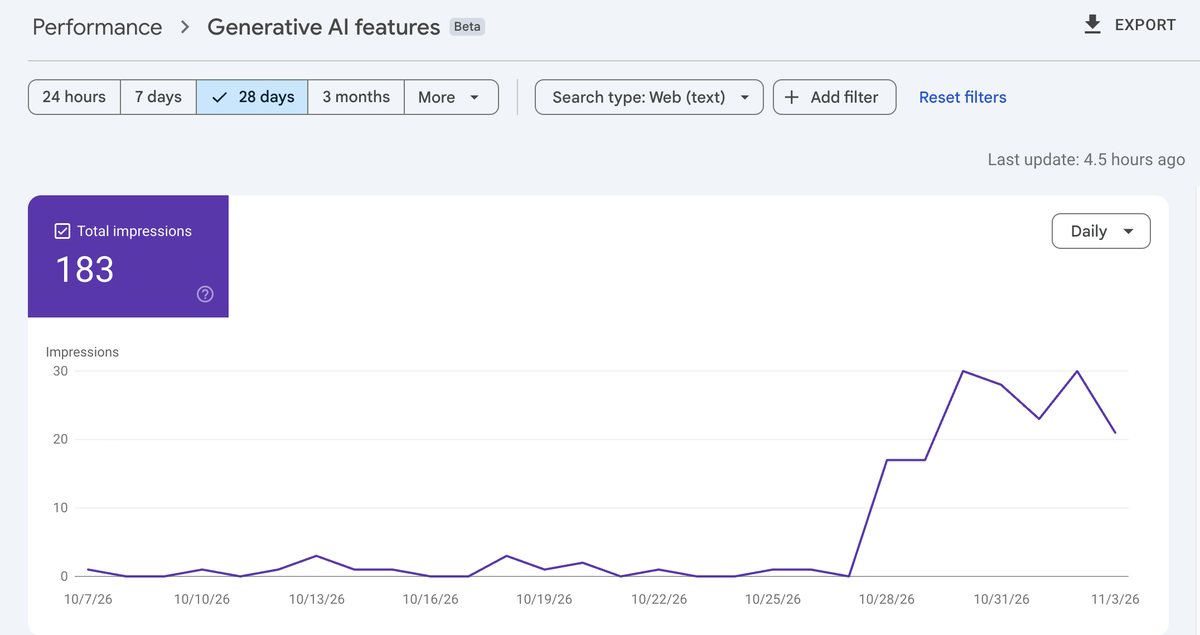
Before the page, Google's AI features only linked to the studio's profile on Maps. Now they link to the website: 166 of 183 impressions in the last 28 days went to the page itself.
A caveat we would rather state than hide: part of these impressions are likely generated by monitoring tools — the queries match our tracked prompts, and some of the traffic is desktop from outside the US. So we read this report as "Google now cites the page", not as a demand figure.
Bing Webmaster Tools' AI Performance report shows the first citations of the site in Microsoft Copilot: four in the month. An early signal, not a stream.
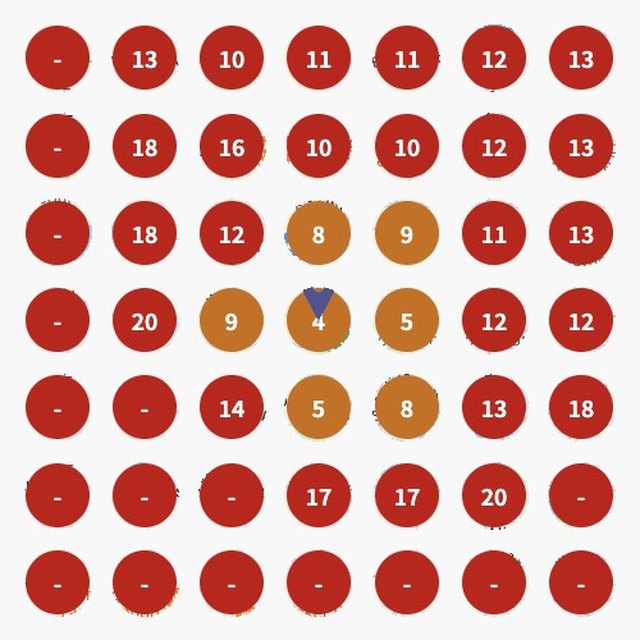
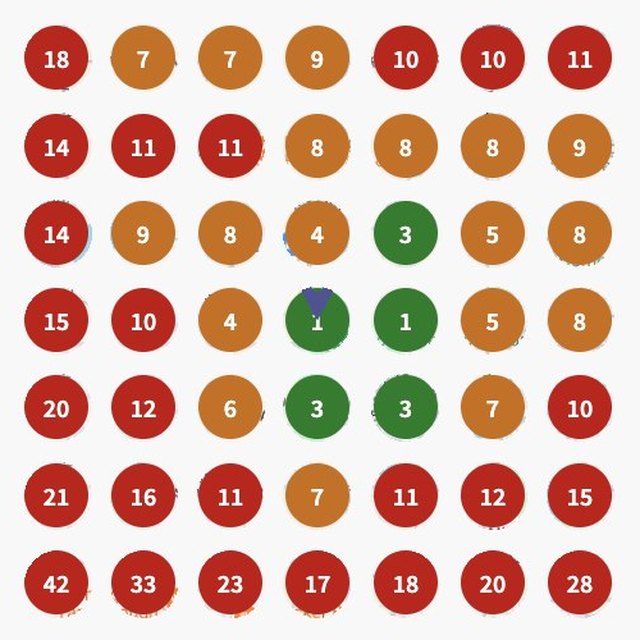
A 7×7 ranking grid around the studio for the most competitive generic query in the niche — the one where specialty does not help. Maps work (profile, categories, reviews strategy) ran in parallel with the site, so this is a result alongside the website, not because of it alone.
Map background removed to keep the location private; grid configuration (radius and step) is the same in both snapshots. Numbers show the studio's rank at each point; "–" means not in the top 20.
In a local niche, AI cites salons' own sites — not only directories. A salon without a site has no source the models can quote beyond its name and address.
One deep page with facts — prices by length, steps, materials, sterilization, warranty, FAQ — gave more than many thin pages would. The models lift ready answers from it.
Structure beats volume. Real tables, lists, Q&A and schema let the models extract facts reliably. The same text as an image or as a marketing paragraph would not have worked.
One set of data everywhere — name, address, phone, hours, links — on the site, in the profile and in the markup. AI and Maps see the same business.
We measure on real local prompts and against named competitors, not on "brand awareness". That is also why the broad city prompt is reported as flat: it was in the panel from day one.
AI answers are built from sources the models can read and cite. Before the website, the studio was already mentioned in about a third of answers, but the citations pointed to a booking page and third-party directories — sources the business does not control and that carry almost no facts about it. Without its own page there was nothing for the AI to quote in detail, so the booking marketplaces and competitors' sites filled that role.
Because AI systems take ready-made answers from a page: a price by nail length, a list of procedure steps, a sterilization routine, a warranty policy. One page that contains all of it in real HTML tables and lists gives the models more to extract than a dozen thin pages with a paragraph each. It is also easier for a small business to keep accurate.
The share of answers from ChatGPT, Perplexity, Google AI Overviews / AI Mode and Copilot that mention the studio, measured on a fixed panel of five local prompts — the questions a real customer would ask when choosing a salon in that city. It is a tracked-prompt metric, not brand awareness in general.
Measurement and content intake in August, a first version of the site in early September, the full page on 3 October, and the figures above were taken a month later. The first changes in citations appeared within two to three weeks of the full page going live.
The broad prompt "best nail salon in [city]" barely changed: 17% → 19%. That prompt is answered from listicles and directories, not from a salon's own site — a pattern we see across niches. Total Google clicks over the month did not grow either; the gains were in AI answers, in the page's ranking position and CTR on the main commercial query, and in Maps.
It depends on the niche, the competition and whether your business has real facts to publish — prices, process, materials, policies. The method is the same; the numbers are not guaranteed. What we can promise is the work: measurement on real local prompts, an intake interview, a page built from your facts, the technical layer, and a monthly report against local competitors.
Data: AI-answer presence, share of recommendations and citations from our AI visibility tracker (Otterly.ai) on five fixed local prompts; Google figures from Search Console; Copilot citations from Bing Webmaster Tools (AI Performance); Maps ranks from a local ranking grid. Abbreviations: NAP — name, address, phone; CTR — click-through rate; FAQ — frequently asked questions; GA4 — Google Analytics 4.
Start with a $35 AI visibility audit: we check what AI answers about your niche in your city, whether you are there, who is recommended instead — and whether your site gives the models anything to cite.
How we work on AI search →