ERMIN MARKETING
Home › Case studies › Contractor
CASE STUDY · AI SEARCH VISIBILITY · CONTRACTOR FOR COMMERCIAL PROPERTIES · CALIFORNIA

AI knew half the business. The other half went from 0 to 44% — once the page said it out loud.

A contractor serving commercial and private properties in California was already recommended by AI for its main service — and never for its second one. The site was a one-page brochure on a website builder. We rewrote it from the owner's facts, then discovered the builder was hiding the new text from crawlers. Here is the whole sequence, including the trap.

Client
Contractor for commercial and private properties, California (name withheld)
Starting point
One-page Wix site: slogans, no prices, no terms, no FAQ; address mismatched with Google profile
Period
23 August → 5 November 2026; new page live 21–22 October
Presence in AI answers
69% → 80% on 5 tracked local prompts; average position 1.08
Second service line
0 mentions → 44% presence
Citations of own site
#1 source in the niche: 179 in 30 days, +35%
In short

Same company, same site address — a page that finally answers

MetricBefore (August)After (November)
Presence in AI answers, 5 tracked local prompts69%80%
Presence on the second service line0 mentions44%
Nearest competitor's presence—20%
Citations of the company's own site, 30 days—179 (#1 in the niche, +35%)
Google AI features: impressions of the page per day1–415–27 (see caveat)
Copilot citations (Bing AI Performance)0 before September30 over six months
Page readiness for AI search (content check)51%72%

Presence = share of answers from ChatGPT, Perplexity, Google AI Overviews / AI Mode and Copilot that mention the company, on a fixed panel of five prompts a local customer would ask. The company was strong on its main service from the start; the work was about the gap, the citations and the page itself.

0 → 44%presence on the second service line — a direct effect of one new block with a price and a process
1.08average position in AI answers: almost always the first recommendation
4×the nearest competitor's presence (80% vs 20%)
30 → 88%question-and-answer readability of the page in the content check
The starting point

A brochure site and a service AI had never heard of

The company does specialised on-site work for commercial and private properties — two service lines, B2B and residential clients, a travel radius across its part of California. A one-page site on Wix's classic editor.

AI already knew the company for its main service: 69% presence on our local prompts in August. For the second line — a service the company sells every week — it had zero mentions. Answers to those prompts were built from directories (BBB, Yelp, Yellow Pages) and competitors' sites.

The page explained why. It was a visiting card: "we go the extra mile", "no project is too big or small". No prices, no lead times, no terms, no service area, no FAQ. The content check scored it 51% ready for AI search, with a 20% score on the summary block and 30% on specificity and question-and-answer readability. And the street address on the site did not match the Google Business Profile — a different house number — so the models were getting contradictory data about where the business is.

What we did

Five steps — and one trap

1
Measurement and a prompt panel

Five strictly local prompts, the way a customer phrases them: "best [service] company in [city]", "[service] near me", "mobile [service] in [area]", the service in a neighbouring city, and the second service line + city. Baseline taken across all engines, plus a content check of the page itself.

2
Interview with the owner instead of copy from the head

A short list of questions: starting prices, minimum order, how soon work can start and how long it takes, payment terms, warranty, which surfaces the company takes on and which it declines, what has to be ready on site, the service radius. Everything that went on the page is a fact from the business.

3
Rewrote the page around how AI picks an answer
Key facts right after the first screenaddress, hours, phone, service area, lead time, terms, warranty
Starting prices in the textper square foot for each service, a day rate for a crew
A separate block for the second service linethe one with zero mentions — what it is, how it is done, from what price
"When we will tell you not to do it"the method's honest limits — an expertise signal, not a sales line
Service areathe list of cities and the travel radius
FAQ to real questionshow much, how soon, what do you need from me on site

One H1, a clear heading hierarchy, and advertising clichés replaced with verifiable facts.

4
The technical layer

Fixed the address so it matches everywhere: site, Google Business Profile, markup. Rewrote the title and meta description for the local query. Added JSON-LD: LocalBusiness with address, hours, services with starting prices, service area and profile links; FAQPage; WebSite. Validated with zero errors. Requested re-indexing in Google Search Console and Bing Webmaster Tools.

5
Found and worked around the builder trap

The first version of the new blocks went in through Wix's "Embed code" element — the way it had worked on other platforms. A look at the page source showed that Wix serves such blocks as an iframe from another domain: the text is not in the page's HTML, and AI crawlers never see it. On screen everything looked right; for the models the page was unchanged.

The fix: key facts, prices, terms and the FAQ duplicated in JSON-LD, which Google and Bing read; and the main text blocks moved into native Wix elements so the words are in the HTML. Only after that did the live page serve the new text to an ordinary crawler — and that is when the metrics moved.

Rule we took away: "visible on screen" is not "visible to AI". On a website builder, check the page source, not the screenshot.

Timeline: audit 23 August → texts agreed early October → page, markup and re-indexing 21–22 October → growth in Google's AI features from 28 October → monthly measurement 5 November.

Results in AI answers

The gap closed, the site became the source

Second service line: 0 mentions in August → 44% presence in November, up 19 points in the last month alone. This is the clearest cause-and-effect in the case: there was no text about the service, the models never recommended it; a block with a price and a process appeared, and so did the recommendations.

Overall presence 69% → 80%, average position 1.08. The company is almost always the first recommendation; the nearest competitor is at 20%.

The company's own site is the most-cited source in the niche: 179 citations in 30 days, up 35%, ahead of BBB and competitors' sites. The models now take the answer from the business itself instead of from a directory.

Content check of the home page23 August5 November
Readiness for AI search (overall)51%72%
Summary block ("who, what, where, from how much")20%65%
Question-and-answer readability30%88%
Specificity30%55%
Clarity60%86%
Section integrity40%78%
Structured data73%85%
Google and Copilot

Google's AI started showing the page every day

A
Generative AI features in Search Console
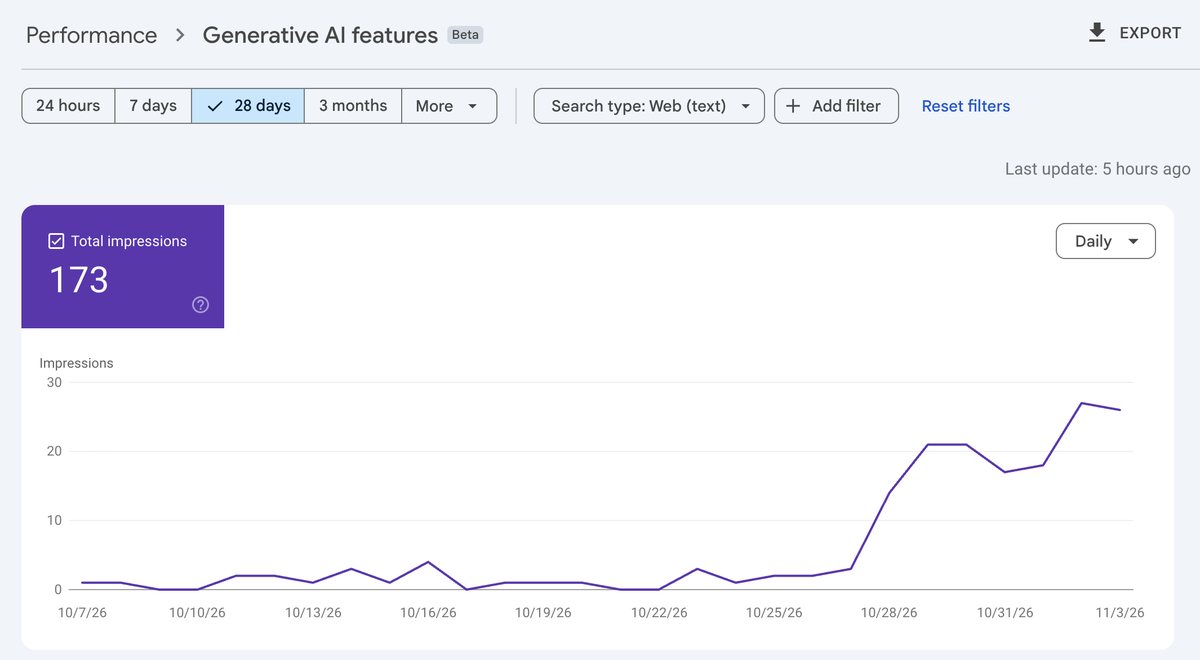
From 7 to 27 October the page averaged 1.4 impressions a day in Google's AI features. From 28 October — six days after re-indexing — 15 to 27 a day. In regular search the page sits in the top 2 for both main service-plus-city queries.

The caveat, stated rather than hidden: this is a week of data, and 62 of the 173 impressions in the window came from the US — the rest are likely monitoring tools, ours included. We read the report as "Google's AI now cites the page regularly" and will confirm the trend over the next months.

Google Search Console, Generative AI features report, 28 days: 0–4 impressions a day until 27 October, then 15–27 a day
Search Console → Generative AI features, 28 days. The step on 28 October follows re-indexing of the rewritten page on 21–22 October.
B
Microsoft Copilot
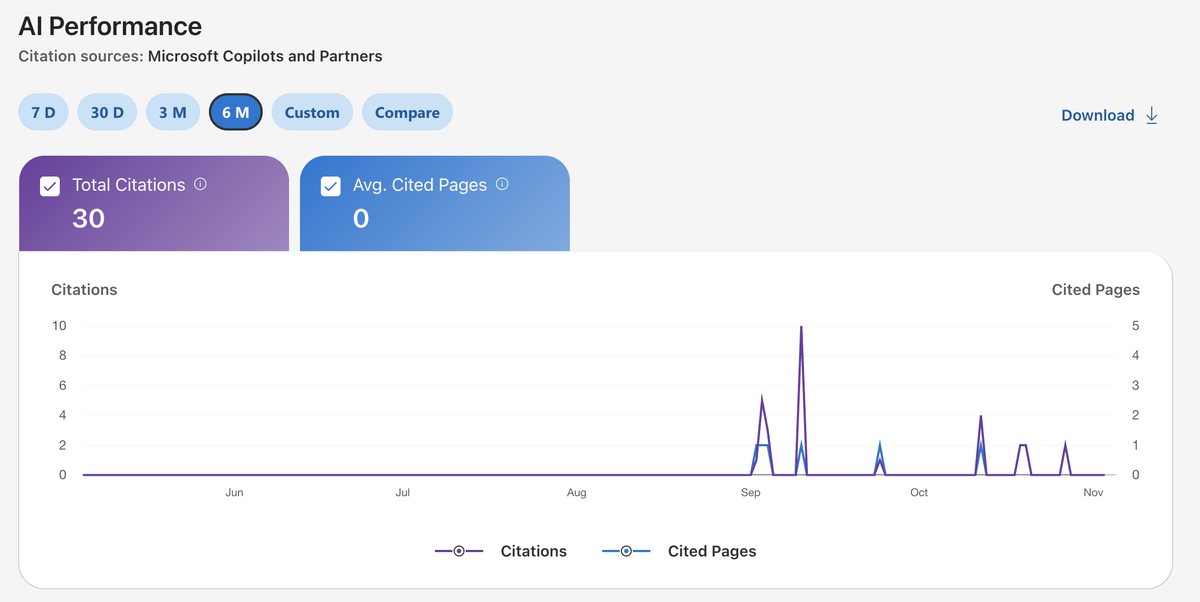
Bing Webmaster Tools' AI Performance report: no citations before September, 30 over six months since — all of them to the home page. Citations come in bursts of a few a day, so this is an early signal rather than a steady stream; the point is that the site now exists for Copilot at all.

Bing Webmaster Tools, AI Performance, 6 months: zero citations until September, then bursts of 2–10 citations a day, 30 in total
Bing Webmaster Tools → AI Performance, six months. Flat until September; 30 citations since.
What this means

For similar businesses

AI picks the business that answers the question, not the one that looks best. Starting prices, lead times, terms, the radius and honest limits did more than any design.

A weak service line is pulled up by its own substantive block. The second service was absent from AI until there was specific text about it with a price and a process.

"On screen" is not "visible to AI". Website builders can hide text in iframes. Check the source, not the picture.

The technical layer is a multiplier, not a substitute for text. A matching address everywhere, LocalBusiness and FAQ markup, and re-indexing in Google and Bing got the new text into AI answers faster.

Caveats. The Google AI series is one week old and partly inflated by monitoring tools. Copilot citations are bursty. Google Business Profile work ran in parallel, so the overall picture is a combined result — the page is the main factor for the engines that read websites. One project is not a guarantee: the numbers depend on the niche and the competition.
The essentials

In five points

  1. The company was already in 69% of AI answers for its main service and in 0% for its second — because the page never described the second one.
  2. We rewrote the one-page site from the owner's facts: key facts, starting prices, a block for the missing service, honest limits, service area, FAQ; fixed the address to match the Google profile; added LocalBusiness, FAQPage and WebSite markup.
  3. Wix served the new blocks as an iframe — invisible to crawlers. Moving the text into native elements and duplicating the facts in JSON-LD is what made the live page readable.
  4. After that: second service line 0 → 44%, overall presence 69% → 80% at average position 1.08, the site the most-cited source in its niche with 179 citations in 30 days.
  5. Google's AI features went from 1–4 to 15–27 impressions a day within a week of re-indexing (early data, partly monitoring traffic); Copilot cited the site 30 times since September.
FAQ

Questions about this case

The company was already in 69% of AI answers. Why do anything?

Because the 69% was all on one service line. On the second line — a service the company actively sells — it had zero mentions in AI answers. The page did not describe that service with a price or a process, so the models had nothing to recommend it with. The goal was not to be mentioned more often; it was to be mentioned for everything the company does.

What exactly was the website builder hiding?

Wix's classic editor inserts custom HTML through an "Embed code" element, which renders as an iframe from a separate domain. On screen the new blocks looked perfect. In the page's own HTML the text was not there — crawlers from Google, Bing and the AI engines saw the old page. We found it by reading the source, not the screen. The fix was moving the key text into native Wix elements and duplicating the facts in JSON-LD markup.

Where do the numbers come from?

AI-answer presence, position and citations come from an AI visibility tracker running a fixed panel of five local prompts across ChatGPT, Perplexity, Google AI Overviews / AI Mode and Copilot. Google figures come from Search Console, including its Generative AI features report. Copilot citations come from Bing Webmaster Tools. The content-quality scores come from a page readiness check run before and after.

Why are you cautious about the Google AI impressions?

The jump in Search Console's Generative AI features report is real but young: a week of data at the time of writing, and only 62 of 173 impressions in the 28-day window came from the US — the rest are likely monitoring tools, including ours. So we report it as "Google's AI now shows the page regularly" and will confirm the trend over the following months.

How long did it take?

Audit on 23 August. Texts agreed with the owner in early October. Page, markup and re-indexing on 21–22 October. The first measurable change in Google's AI features came within a week; the AI-answer figures are from the monthly measurement on 5 November. Google Business Profile work ran in parallel, so the Maps side is a combined result.

Will this work for my business?

If your site is a brochure — slogans, no prices, no terms, no service area, no FAQ — there is usually room. If it sits on a website builder, the first thing to check is whether the text you see is actually in the HTML. The method is the same for any local service business; the numbers depend on your niche and competition, and we promise the work, not a figure.

Sources and tools

Data: AI-answer presence, position and citations from our AI visibility tracker (Otterly.ai) on five fixed local prompts, plus its page content check; Google figures from Search Console; Copilot citations from Bing Webmaster Tools (AI Performance). Abbreviations: NAP — name, address, phone; JSON-LD — the format for Schema.org markup; FAQ — frequently asked questions; BBB — Better Business Bureau.

Contact

Is your site a brochure — or an answer?

Start with a $35 AI visibility audit: what AI answers about your niche in your city, whether you are there for every service you sell, and whether the text on your site is actually in the HTML.

Phone / WhatsApp+357 97000136
CompanyErmin Marketing Ltd
How we work on AI search →