ERMIN MARKETING
Home › Google Ads management › Case study
CASE STUDY · PERFORMANCE MAX · LOCAL BUSINESS · MAJOR US CITY

Same budget. 7.5× more value from Google Ads.

A premium local service business was getting hundreds of calls a month from Google Ads — and most of them were the wrong calls. We did not touch the budget. We changed what the algorithm was learning from, and only after months of preparing the data. Here is the before and after, step by step.

Client
Premium local service business, major US city
Campaign
Google Ads Performance Max
Compared
2 months before vs 2 months after the switch
Budget
$12,127 → $12,435 (unchanged)
Tracked value
$3,128 → $23,464
ROAS
0.26 → 1.89
In short

Three times fewer calls — 7.5 times more money

Both periods are two months long, with practically the same spend. The only thing that changed is the bid strategy — and the months of data work that made the change possible.

MetricBefore (2 months)After (2 months)
Ad spend$12,127$12,435
Tracked conversion value$3,128$23,464
ROAS (return on ad spend)0.261.89
CTR (click-through rate)0.65%1.13%
Average CPC (cost per click)$2.15$1.50
Phone calls672236
Store visits31860

Tracked conversion value is the sum of deal amounts the client confirmed in the CRM and we sent back to Google Ads, plus store visits counted at $1 each. ROAS = conversion value ÷ ad spend; it is a sales figure, not profit.

7.5×more tracked value from the same budget
$1.89back in tracked sales for every $1 spent (was $0.26)
−30%cost per click: the ads reach a more interested audience
−65%calls — the ones that never turned into deals are gone
The problem

Hundreds of cheap leads — and an unhappy owner

The client offers a premium version of a common local service in one of the largest US cities. Google Ads was bringing in a lot of calls, but the owner was frustrated: most callers were looking for the budget option, had dialed the wrong business, or were trying to reach a competitor.

On paper the campaign looked healthy: hundreds of conversions a month, a low cost per lead. In reality only a small share of those calls produced money, and the bulk of the budget bought traffic the business could not — and did not want to — serve.

Why it happened

The campaign ran on Maximize conversions. For the algorithm every conversion weighed the same: a call that led nowhere and a call that closed a large deal were equal.

So the algorithm did exactly what it was asked: it hunted for the cheapest, most frequent conversions. The cheapest ones come from broad, budget-driven searches. The better it "optimized", the further it drifted from the target customer.

The problem was not the targeting settings. It was what the algorithm was learning from.

What we did

Four steps — in this order

1
Connected the ads to real money
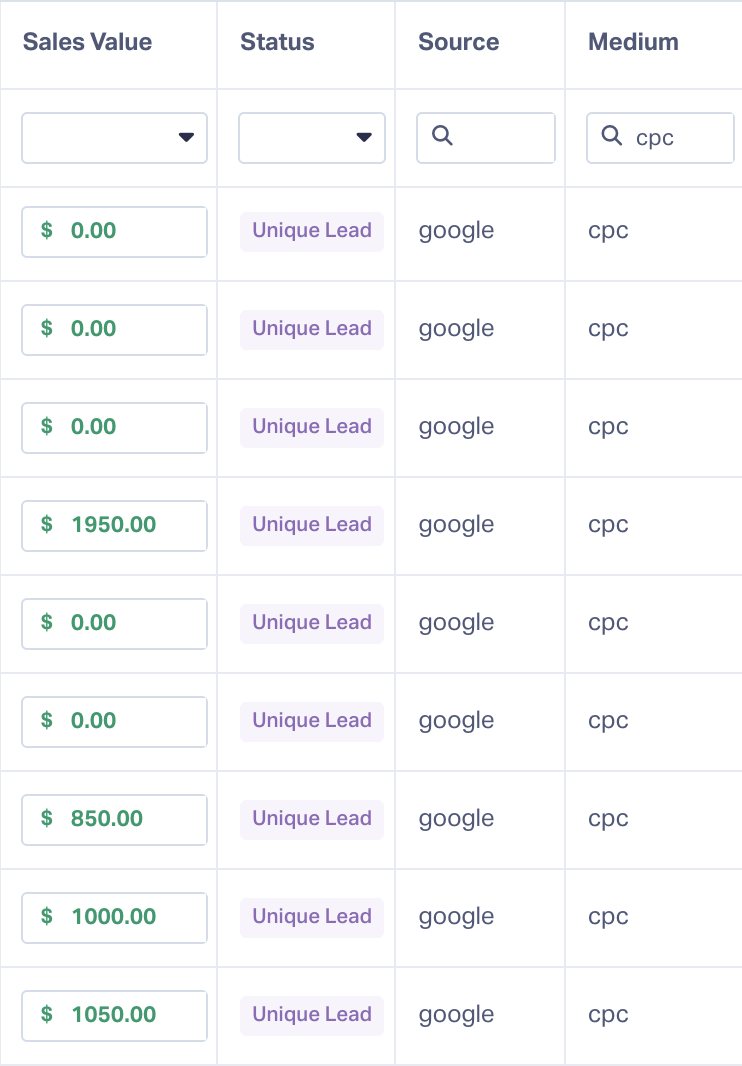
We set up a CRM → Google Ads loop. Every lead from ads lands in the CRM; the client confirms whether it is a real prospect and enters the deal amount. That value goes back to Google Ads automatically and is attached to the original click. If a deal closes later, the value is updated retroactively.

For the first time Google saw not just "a call happened", but "this call brought $1,950 — and this one $0".

Without this step nothing else works: value-based bidding can only learn from values that actually reach Google Ads — and most accounts never send any.

CRM lead list filtered by source google / medium cpc: Sales Value column with $0.00 on most leads and $1,950, $850, $1,000, $1,050 on confirmed deals
Step 1 in practice: the client's CRM, filtered by google / cpc. Most leads carry $0; the confirmed deals carry their real amounts — and only those amounts go back to Google Ads.
2
Cleaned the incoming traffic

We went through every search term the ads had shown for and matched it against confirmed deals. Budget-driven and irrelevant demand was cut — but not blindly: some broad terms that looked like junk were actually producing target sales. Negative keywords were built from data, not intuition.

3
Let the data accumulate

The least obvious step: we waited. Switching to value-based bidding right away would have been a mistake — the campaign history did not yet have enough deals with real amounts, and the algorithm would have learned from an incomplete picture.

We kept the old strategy for months, until the account had enough confirmed conversions with correct values and the average conversion value in Google Ads matched the business's real average ticket. That was the readiness signal.

4
Switched to Maximize conversion value
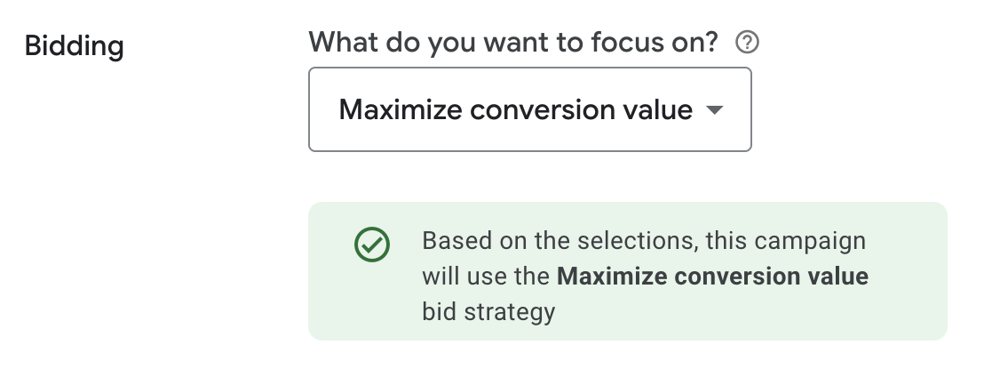
Only then did the campaign move to optimizing for value. Now the algorithm is not looking for people who will call — it is looking for people who will bring in a deal. The budget was deliberately left unchanged so the result would be comparable.

Google Ads campaign settings: bidding focus set to Maximize conversion value
Step 4 in practice: the campaign's bidding focus after the switch. The setting itself takes a minute — getting the account ready for it took months.
The result

Same campaign, same spend, two months apart

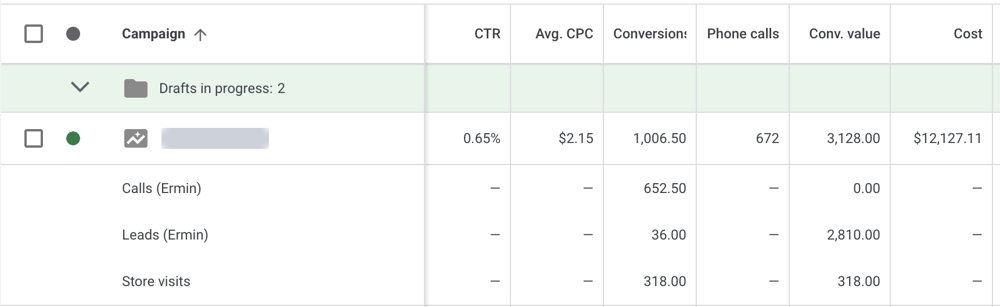
Google Ads campaign report, two months before: CTR 0.65%, avg. CPC $2.15, 672 phone calls, conversion value $3,128, cost $12,127
Before — Maximize conversions, 2 months: 672 calls, $3,128 tracked value, $12,127 spent. Calls carried no value yet; the value came from a few forms and store visits.
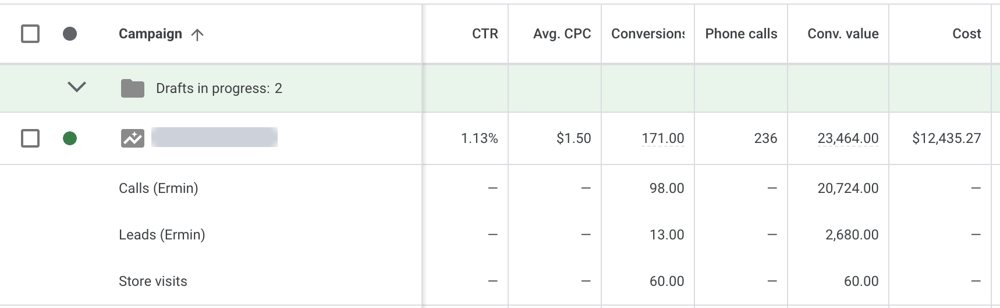
Google Ads campaign report, two months after: CTR 1.13%, avg. CPC $1.50, 236 phone calls, conversion value $23,464, cost $12,435
After — Maximize conversion value, 2 months: 236 calls, $23,464 tracked value, $12,435 spent. 98 verified calls alone carry $20,724 of it.

Tracked value grew from $3,128 to $23,464. ROAS went from 0.26 to 1.89: every dollar spent now brings back almost two in tracked sales.

CTR rose from 0.65% to 1.13% and the average click fell from $2.15 to $1.50. The ads are being shown to a more interested audience, and Google charges less for it.

Calls dropped from 672 to 236. The calls that never produced money are gone — which is exactly what the owner wanted.

Store visits dropped from 318 to 60. This matters: these are people who saw the ad and then walked into the location, which Google detects from device location. For a walk-in business that is real demand, and it also feeds the algorithm indirectly. But the campaign was measured on calls and leads with confirmed amounts, and store visits were counted at a nominal $1 — so this drop sits outside the value figures above and is worth watching separately.

What this does not mean

It is not a button — and not a magic pill

Value-based bidding works, but not by flipping the setting. Switch a campaign to conversion value without preparation and the algorithm learns from empty or distorted data — and the result is worse than before.

The sequence that works: real deal amounts flowing from the CRM → clean incoming traffic → months of accumulated data → only then the change of strategy. Stable, long-term results in Google Ads — the kind many accounts never reach — take that much work. Probably like anything else.

Whether it fits your business depends on the niche, the average ticket, and how many deals the account can accumulate. A business with a handful of deals a month will need longer; a business where every lead is worth about the same gains little from it. What we can promise is what we work on, not the outcome.

And fewer calls is not always bad news. Sometimes it means the ads have finally stopped paying for people who don't buy.

The essentials

In five points

  1. Maximize conversions treats a $0 call and a $1,950 deal as equal — so it chases the cheapest leads, which for a premium business are the wrong ones.
  2. The fix starts in the CRM: the client confirms real prospects and enters deal amounts; those values go back to Google Ads and attach to the original click.
  3. Negative keywords are built from confirmed deals, not from how a search term looks — some "junk" terms were actually selling.
  4. The switch to Maximize conversion value came only after months of data, when the average conversion value in Google Ads matched the real average ticket.
  5. Same budget, comparable two-month periods: tracked value $3,128 → $23,464, ROAS 0.26 → 1.89, calls 672 → 236.
FAQ

Questions about value-based bidding

What is the difference between Maximize conversions and Maximize conversion value in Google Ads?

Maximize conversions treats every conversion as equal and looks for the cheapest, most frequent ones — for a local business that usually means broad, budget-driven searches. Maximize conversion value optimizes for the total value of conversions, so a $1,950 deal weighs more than a $0 call. The second strategy only works if Google actually receives real deal values for each conversion.

Why did the number of calls drop after the switch?

Calls went from 672 to 236 over comparable two-month periods because the algorithm stopped paying for the cheap, off-profile calls that never turned into deals. That was the owner's main complaint. Tracked value from the campaign went from $3,128 to $23,464 on the same budget, so fewer calls meant more business, not less.

How do you get real deal values into Google Ads?

Every call and form from ads lands in the CRM. The client marks whether the lead is a real prospect and enters the deal amount. That value is sent back to Google Ads and attached to the original click, using Google's offline conversion import. If a deal closes later, the value is updated retroactively. Google then sees not just "a call happened" but "this call was worth $1,950 and this one $0".

Can I just switch my campaign to Maximize conversion value?

You can, but without preparation it usually makes things worse. If the account has no real values — or values on only a handful of conversions — the algorithm learns from an empty or distorted picture. In this case we kept the old strategy for months while confirmed deals with correct amounts accumulated, and switched only when the average conversion value in Google Ads matched the business's real average ticket.

What does ROAS 1.89 mean?

ROAS (return on ad spend) is tracked conversion value divided by ad cost. 1.89 means that for every dollar spent on ads, the campaign brought back $1.89 in tracked sales value. Before the change the same campaign was at 0.26. ROAS is revenue-side, not profit — the margin on those sales is the business's own number.

Will this work for my business?

It depends on the niche, the average ticket, and how many deals the account can accumulate. Value-based bidding needs enough confirmed conversions with real amounts to learn from; a business with a handful of deals a month will take longer, and a business where every lead is worth about the same gains little from it. What we can say is what we work on: CRM verification, value import, clean search terms, and the switch only when the data is ready.

Sources

Abbreviations: ROAS — return on ad spend; CTR — click-through rate; CPC — cost per click; CRM — customer relationship management system; PMax — Performance Max campaign type.

Contact

Is your Google Ads paying for the wrong calls?

Start with a $35 audit: we review your campaigns and conversion tracking, and tell you whether the account is ready for value-based bidding — or what has to be built first.

Phone / WhatsApp+357 97000136
CompanyErmin Marketing Ltd
How we manage Google Ads →